Tolon
Cartes Postales from GreeceTolon is the seaside base where Ellie Thomas’s imagined Greece becomes a lived experience, and where she reads the stories that connect her journey to Anthony. Staying by the beach and travelling regularly to Nafplio, she finds a rhythm that lets her explore without losing the quiet time she wants for the notebook. The town is not merely another destination on a map: it is the setting in which postcard longing gives way to direct experience and a decision to find the person whose writing has accompanied her.
Arrival and Setting
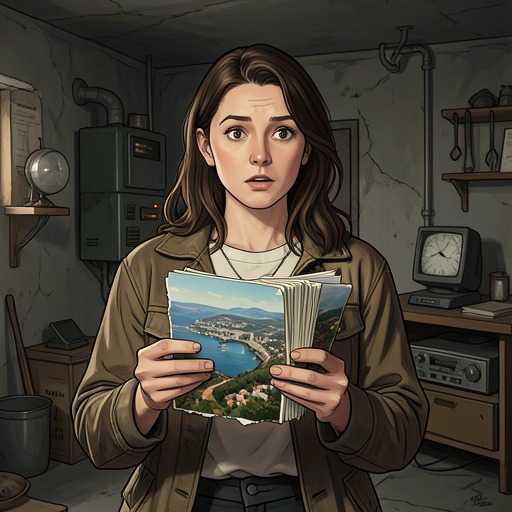
Ellie Thomas’s journey to Tolon grows out of months spent watching Greece take shape on a corkboard in her London flat. The anonymous postcards, signed only with an A, gathered into a blue-and-white mosaic of skies, sea, boats and whitewashed buildings. Their place names—among them Kalamata, Kalavrita and Kosmas—made a country she had never visited feel increasingly present in her life. The postcards could offer only a glimpse, not the scents or sounds of the places they showed, but that partial view strengthened her desire to go.
After a month without a card, Ellie Thomas books a flight to Athens and chooses a week’s half-board stay near Nafplio. In Tolon, she arrives by taxi at Hotel Marina, initially unsure as she gives the destination. The trip is a spontaneous choice, but one prepared by the images and names she has been collecting. Tolon becomes her first settled base in Greece rather than simply a point passed through: it gives her a beach to return to and a practical starting place for visiting Nafplio.
A Base for Exploring
By her fourth day in Greece, Ellie Thomas has made a regular pattern of the stay. She swims and sunbathes on the beach by her hotel during the day, then takes a bus to Nafplio in mid-afternoon. There she explores a different part of the town each day, including a castle, a church and a museum, before having a drink in the square and catching a bus back to Tolon in time for dinner. Anthony’s descriptions had prepared her to expect beauty and history; visiting for herself confirms that the place has the richness his writing suggested.
Her response also moves from private fascination toward sharing what she sees. On her second day, she writes a postcard to her mother, knowing that her mother will be hoping to hear from her. The old-fashioned ritual of writing the card and fitting six stamps around the limited space for the address makes her smile. She describes Nafplio enthusiastically and says that it has something special about it. To her friends she sends texts with a selfie against the sea instead. These different messages mark distinct ways of keeping in touch: the postcard carries her discovery home, while the texts register the holiday in a more immediate form.
Reading Anthony’s Notebook
Tolon also provides the privacy and atmosphere Ellie Thomas wants for reading Anthony’s notebook. She saves it for the evenings and reads a few stories at a time on her balcony, away from the bar’s pop music and the beat of beach tennis. The stillness of night, bright stars, cicadas and waves shape the setting in which she encounters the stranger’s thoughts. Reading in small portions makes the notebook part of the stay’s daily rhythm rather than an interruption to it.
The writing gives Ellie Thomas another route through Greece, but does not replace her own experience. She checks distances on a map and considers day trips to places Anthony visited, including Preveza and Patras. Reception enquiries convince her that even a return journey to Kalamata cannot be managed in a day, so she decides to stay in Tolon and Nafplio. The limitation matters: the trip cannot simply reproduce Anthony’s route. For now, his descriptions must stand in for places beyond her reach, while the scents, language, food and people of the country she is actually visiting become familiar through her own senses.
Departure and Narrative Significance
As her holiday ends, the thought of leaving Tolon brings the days’ sensory traces into focus. Ellie Thomas packs clothes that smell of sun cream and are crisp with salt and sand; she is saddened by the prospect of washing away the aroma of the days she has enjoyed. She considers leaving her sarongs unwashed and hanging them in her flat until the scents of sunshine and summer fade naturally. The impulse to preserve these traces echoes the postcards on her old corkboard: both make travel present beyond the moment of seeing, though now the memory is attached to her own belongings and experience.
The following morning, Ellie Thomas leaves the hotel after breakfast, takes a taxi to Nafplio for one last coffee in the square, and then boards a bus to Athens. Her flight is not until the next morning, but she also intends to visit the Acropolis and deliver the notebook. Later, when she meets Anthony, she tells him about staying in Tolon and visiting Nafplio each day. The town thus stands at the hinge between the two parts of her journey: the inward experience of reading his account and the outward step of returning the notebook to its writer. What began as longing for the blue skies in someone else’s postcards has become a holiday she can describe from experience—and a reason to seek a human connection beyond the page.